
 how-to
How to Spot Fitness Pseudoscience: A Practical Guide
Last Updated: October 29, 2026
Quick Summary
Fitness pseudoscience is any training or nutrition claim presented as science without real scientific support. To spot it, write down the exact claim, ask what evidence backs it, check who benefits, look for a mechanism, and search for qualified experts who disagree. If a claim fails two or more checklist boxes, set it aside.
- Bold claims like lose belly fat in 7 days travel faster than careful studies.
- Testimonials and before-and-after photos are stories, not evidence of what will happen to you.
- Study design sets the ceiling on what a result can prove, from anecdote to meta-analysis.
- A proprietary blend hides each ingredient's dose, so you cannot compare it to research.
- If a claim fails the source box on the checklist, drop it entirely.
Table of Contents
- Why Fitness Pseudoscience Spreads So Easily
- Fitness Pseudoscience Red Flags to Watch For
- How to Evaluate Fitness Claims Step by Step
- How to Judge the Studies Behind a Fitness Claim
- Fitness Misinformation Examples You Will Recognise
- Your Fitness Claims Fact-Checking Checklist
- Checking Credentials, Conflicts, and Supplement Marketing
- Build Your Own Evidence-Based Reference Shelf
- Frequently Asked Questions
Why Fitness Pseudoscience Spreads So Easily
Fitness pseudoscience is any training or nutrition claim presented as science without real scientific support.
- Bold claims travel fast. "Lose belly fat in 7 days" needs no explanation.
- Real science sounds uncertain. Researchers use words like "may" and "suggests."
- Nobody checks the source. Most people share before they verify.
Health misinformation is not a small problem. The World Health Organization on infodemics has warned that false health information spreads faster than facts and can cause real harm.
The good news: spotting fitness pseudoscience is a learnable skill. It takes a few questions, applied consistently.
Fitness Pseudoscience Red Flags to Watch For
The fastest way to catch fitness pseudoscience red flags is to listen for how a claim is phrased. Weak claims usually announce themselves in the first sentence.
Language That Signals a Weak Claim
Watch for these phrases:
- "Doctors don't want you to know..."
- "One weird trick..."
- "Guaranteed results in X days"
These lines promise a shortcut and pre-empt criticism by blaming a hidden enemy, a classic sign of unsubstantiated claims.
Real exercise science rarely sounds this confident. A trainer citing research will say what the study found, who it studied, and what it does not prove. If a claim has no limits, no conditions, and no exceptions, treat it as marketing until proven otherwise.
Testimonials, Before-and-After Photos, and Anecdotal Evidence
Testimonials are not evidence. They are stories, not lies, but weak proof.
A single person's result cannot tell you what will happen to you. Before-and-after photos can be staged with lighting, posture, and timing. Some are edited outright. Even honest photos show one person, not a pattern.
How to Evaluate Fitness Claims Step by Step
Learning how to evaluate fitness claims comes down to a short, repeatable process. Run every claim through the same five steps.
- Find the exact claim. Write it down as stated. Vague claims are hard to test, which is often the point.
- Ask what evidence backs it. Look for a named source, study, or citation. If there is none, stop here.
- Check who benefits. Does the person making the claim sell a product tied to it?
- Look for the mechanism. Does the claim explain how it works in plain terms, or just assert that it does?
- Search for disagreement. Look for qualified people who push back. A claim that survives expert scrutiny is stronger.
For a deeper walk-through of applying these standards to real programs, see our guide on how to pick science based training programs 2026.
Run every fitness claim through the same five steps before you trust it.
| Step | What to do |
|---|---|
| 1 | Find the exact claim and write it down as stated |
| 2 | Ask what evidence backs it; look for a named source |
| 3 | Check who benefits from the claim |
| 4 | Look for the mechanism explained in plain terms |
| 5 | Search for qualified experts who disagree |
How to Judge the Studies Behind a Fitness Claim
A study citation is only as good as the study. Many fitness claims borrow the look of research without the substance. Here is a practical way to read the study behind a claim, the same questions a careful reviewer would ask.
The Five Study Questions to Ask
When someone shows you a study, run it through these five questions before you accept the claim.
-
What kind of study is it? Study design sets the ceiling on what a result can prove. From weakest to strongest:
- Anecdote or case report, one person's experience. Generates questions, does not prove a method works.
- Cross-sectional survey, a snapshot. Cannot show cause and effect.
- Observational cohort, follows a group over time. Shows associations, but confounding is a real risk.
- Randomized controlled trial (RCT), random assignment to treatment or control. Strongest single-study design for cause and effect.
- Systematic review or meta-analysis, pools multiple studies. Strongest overall when the included studies are good.
-
How many people, and who were they? Sample size matters, but so does the population. A trial of 12 trained college athletes tells you little about a 45-year-old beginner. A single small study is a hint, not a verdict.
-
Was there a control group, and was it blinded? A control group shows what would have happened without the intervention. Blinding reduces bias, but in exercise studies it is often impossible, which is why researchers rely on control groups and objective outcomes.
-
What was measured, and how? Self-reported food intake and training are noisy measures. Objective measures, body composition scans, blood markers, performance tests, carry more weight.
-
Has it been replicated? One study is a data point. Replication means other researchers, ideally independent ones, got the same result. A claim resting on a single unreplicated trial is provisional, no matter how confident the headline sounds.
Correlation vs Causation in Fitness Claims
This is the trap most people fall into. Two things happening together does not mean one caused the other.
A common pattern: people who take creatine also train harder, sleep more, and eat more protein. If they gain muscle, the supplement gets credit for all of it.
Another pattern: people who stretch are less likely to be injured. Does stretching prevent injury?
What a Strong Study Looks Like in Practice
When a fitness claim arrives with a study attached, look for these markers:
- A named journal and a link you can open. If you cannot find the paper, treat the citation as unverified.
- A stated sample size and population. You want to know how many and who.
- A control or comparison group. Without one, the result is hard to interpret.
The U.S. National Library of Medicine on evaluating health information lays out how to weigh study types and check whether a source is trustworthy.
Fitness Misinformation Examples You Will Recognise
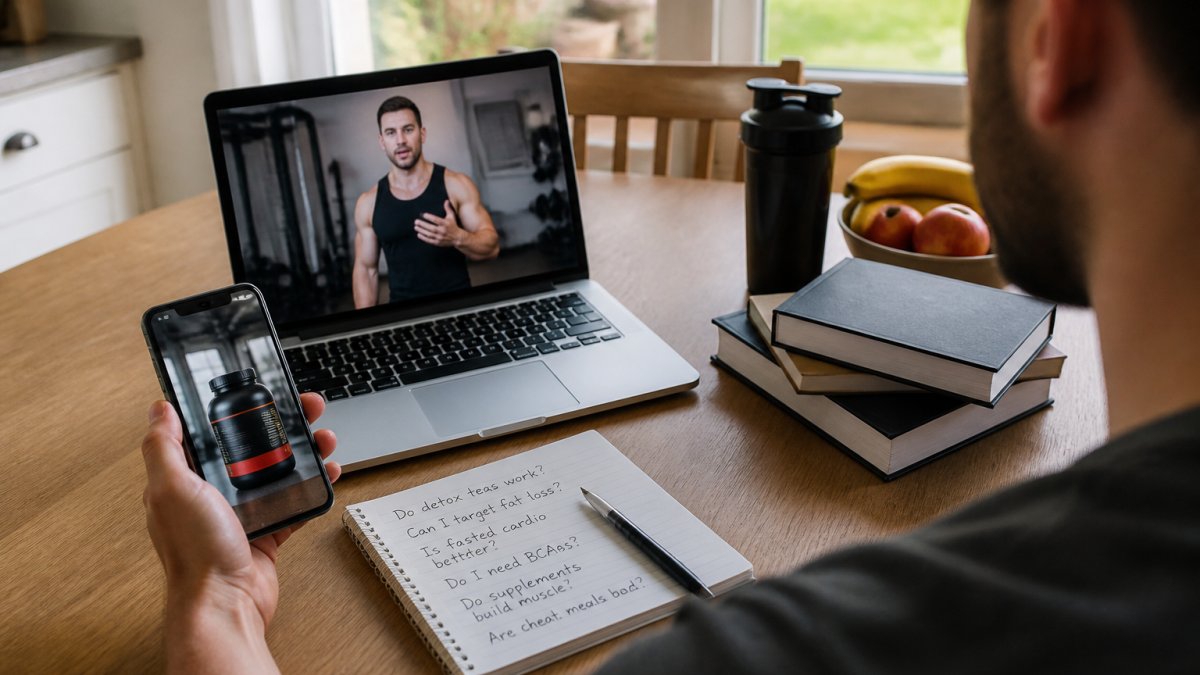
Some fitness misinformation examples show up so often they feel normal. Here are the ones you will meet most.
- "Boost your immune system with this powder." No single product boosts immunity; sleep, nutrition, and activity do.
- "Detox teas flush toxins." Your liver and kidneys already do this.
- "Spot reduction burns fat from one area." Training a muscle does not burn fat over it; fat loss happens across the body.
Each of these claims sounds plausible. Each one fails when you ask for evidence and a mechanism.
Your Fitness Claims Fact-Checking Checklist
A fitness claims fact-checking checklist turns skepticism into a habit. Run this list before you trust, buy, or share any claim.
- Is the exact claim written down and specific?
- Is there a named source, study, or citation?
- Does the source exist, and can I find it independently?
If a claim fails two or more boxes, set it aside. If it fails the source box, drop it entirely.
Checking Credentials, Conflicts, and Supplement Marketing
Supplement marketing is where fitness pseudoscience gets most aggressive. Products promise more than any training program could deliver, and the labels are built to sound scientific. This section gives you a concrete way to check the person and the product, not just the claim.
How to Verify a Fitness Influencer's Qualifications
A confident voice and a large following are not credentials. Before you trust advice, check what the person is actually qualified to say.
- Find the exact credential and who issued it. A real certification is verifiable through the certifying body. Ask for the full name and issuing organization, then check that organization's site for a directory or verification page.
- Distinguish scope. A personal trainer certification covers exercise programming, not clinical nutrition or medical treatment. A registered dietitian has clinical training; a "nutrition coach" may have completed a short online course. Match the credential to the claim.
- Look for a license where one is required. Providing individualized medical nutrition therapy or diagnosing conditions often requires a license. Advice crossing into medical territory from an unlicensed source is a red flag.
Spotting Conflicts of Interest
Conflicts of interest do not automatically make someone wrong, but they change how you should read their advice.
- Sponsorships and affiliate links. If an influencer is paid by a supplement brand, their review of that brand is not neutral. Look for disclosure statements.
- Discount codes and "partnerships." A code that gives you a discount usually gives the creator a commission, a commercial relationship, even when framed as a personal recommendation.
- Ownership and equity. The strongest conflict is when the person owns part of the company selling the product. Disclosure is often buried; look for it.
A useful test: ask whether the person would give the same advice if they made no money from it. If the answer is unclear, treat the advice as marketing until you can verify it independently.
Supplement and Product Marketing Red Flags
Labels and sales pages are designed to sound scientific. Here is what to watch for.
- Proprietary blends. A single label like "proprietary blend" hides the dose of each ingredient. Without doses, you cannot compare the product to the research.
- "Clinically proven" with no citation. If the phrase appears without a study you can open, treat it as a slogan, not evidence.
- Testimonials from models rather than named customers. Stock-photo testimonials and context-free before-and-after photos are marketing, not proof.
A Quick Verification Routine
When a fitness influencer or product pitch reaches you, run this short routine:
- Name the credential and verify it through the issuing body's site.
- Check the disclosure for sponsorships, affiliate codes, or ownership.
- Open the label or sales page and look for doses, citations, and disease claims.
- Search for independent coverage from a source that does not sell the product.
Our own methodology explains how we cite claims and separate evidence from opinion, so you can hold us to the same standard.
Build Your Own Evidence-Based Reference Shelf
The strongest defense against fitness pseudoscience is a small shelf of sources you trust. Build it once, and you stop starting from zero every time a new claim appears.
Start with these categories:
- One textbook or field guide on exercise science basics
- One nutrition reference grounded in research
- One source on study literacy, so you can read papers yourself
Keep the shelf small and cited. A handful of solid sources beats a hundred bookmarked videos.
At The Sequeira Library, we built our collection around exactly this idea.
You can browse the full catalogue to see which titles fit your goals.
Frequently Asked Questions
What are the warning signs of pseudoscience in fitness?
The clearest signs are bold promises with no cited evidence, claims that one method works for everyone, and heavy reliance on testimonials instead of research. Watch for phrases like 'secret' or 'clinically proven' with no study named, a single mechanism used to explain everything, and refusal to acknowledge risks. If a claim cannot be traced to peer-reviewed research and the person making it will not show their sources, treat it as unsubstantiated until proven otherwise.
How can you tell whether a fitness claim is evidence-based?
Ask three questions: what is the source, what kind of study is it, and does the claim match what the study actually found? Evidence-based fitness advice cites peer-reviewed research, separates fact from opinion, and describes the population and conditions the finding applies to. A claim that survives replication across several studies and is consistent with established exercise science or nutrition advice is far stronger than one resting on a single trial or a coach's personal experience.
Are testimonials and before-and-after photos reliable evidence?
No. Testimonials are anecdotal evidence, and before-and-after photos can be shaped by lighting, posture, angles, and timing. They show that one person got one result, not that the program caused it. A supplement or workout plan marketed mainly through transformation photos is a fitness pseudoscience red flag, because real efficacy would be supported by controlled research rather than selective evidence chosen to persuade.
How do you check whether a fitness expert is qualified?
Look for recognised certifications and credentials, then check what they actually cover. A personal trainer with a respected certification can coach training but is not automatically qualified to give clinical nutrition advice. Also look for conflicts of interest: does the expert sell the supplement they recommend? Do they disclose affiliate links? An honest source labels opinions as opinions, cites sources for factual claims, and is upfront about what they earn from their recommendations.
The real challenge is not finding more fitness content. It is finding content you can trust and check. The Sequeira Library gives you 97 evidence-based books, field guides, programs, and cookbooks, each with cited claims, labeled opinions, and a complete audiobook. Start free and build a reference shelf that holds up to scrutiny.